
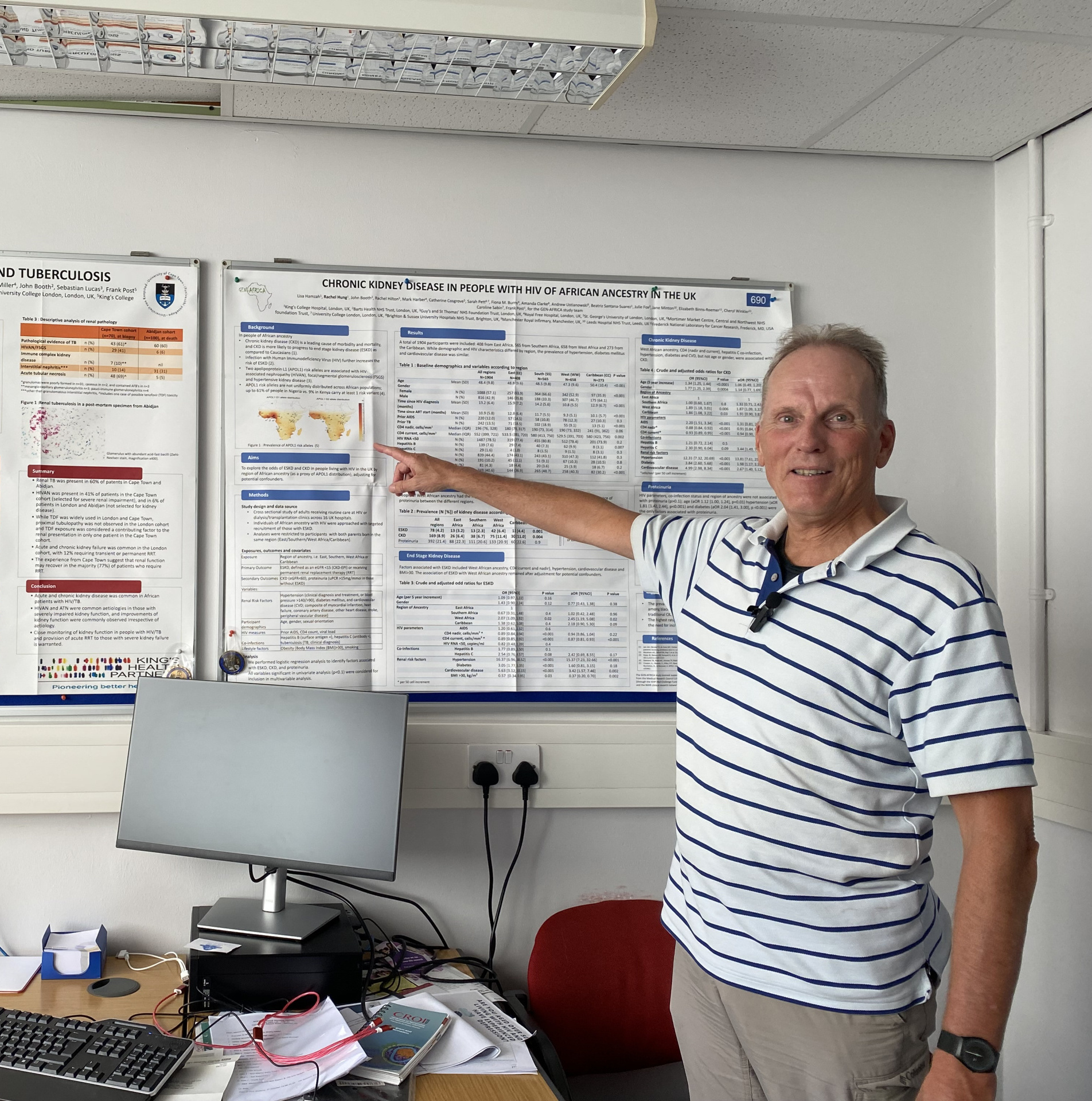
Prof Frank Post
“If the people included in research do not reflect those who will use a treatment, the evidence generated may not be sufficiently representative.”
Advancing HIV research and inclusive clinical trials: Insights from KHP Chief Investigator Prof Frank Post
DS: For readers who may not know your work, could you tell us about your clinical and research interests, and what first attracted you to HIV medicine?
FP: I am an HIV physician and have been at King’s College Hospital for 22 years, where I lead a research programme focused on kidney disease in people living with HIV.
My interest in HIV developed from my early clinical work in South Africa. I initially intended to specialise in cardiology, with a focus on rheumatic heart disease, but while in clinical training and conducting research in people with tuberculosis, I witnessed the rapid escalation of the HIV epidemic, with hospitals increasingly overwhelmed by patients with HIV, tuberculosis and other opportunistic infections, at a time when HIV treatment was denied to the population and stigma surrounding HIV made it difficult for many people to access care and support.
This experience shaped the direction of my career. I specialized in Infectious Diseases and completed a PhD in tuberculosis. My arrival in 2004 in South London coincided with an increased migration from sub-Saharan Africa, population in whom kidney disease is much more common, and the widespread introduction of tenofovir in HIV clinical practice, an anti-retroviral drug that may cause kidney injury.
My research has been focused on the effects of HIV medications on the kidney, the epidemiology of kidney disease among people of African ancestry with HIV and, more recently, the genetic susceptibility to kidney disease in Black populations.
DS: Much of your work has focused on kidney disease and other long-term complications in people living with HIV. Why is this area important, and what have been some of the most significant advances you have witnessed during your career?
FP: When I arrived in London, there was an opportunity to develop research and clinical expertise in kidney disease among people living with HIV as this was not previously seen as a priority. We established a dedicated research programme and extensive research collaborations, developed expertise in this area, and a clinical service that other clinicians could turn to.
This work has helped establish a strong foundation for understanding and managing kidney disease in people with HIV, and has informed guidelines for kidney disease monitoring, management of HIV in the setting of kidney disease, and kidney transplantation in people with HIV.
DS: The GenAfrica study has recruited thousands of participants and generated important insights into kidney disease in people of African ancestry with HIV. What have you learned from leading research at that scale?
FP: The GenAfrica study was set up to investigate associations between variants of the APOL1 gene and kidney failure in people of African ancestry with HIV. These variants are only encountered in people of recent African ancestry in whom they provide protection against sleeping sickness (Human African Trypanosomiasis), a protozoal infection transmitted by Tse-Tse flies.
We found that carrying two variants, which is particularly common among people of West-Africa and Caribbean ancestry, increases the risk of kidney failure by 10-fold, and the risk of HIV-Associated Nephropathy (HIVAN) by about 30-fold. This explains why, with large population of West-African and Caribbean ancestry in South London, we see large numbers of individuals from these communities who have developed kidney failure requiring dialysis and transplantation.
We have also demonstrated an increased risk of kidney disease in individuals with sickle cell trait and have extensively evaluated insulin resistance, socio-economic deprivation, multi-morbidity, COVID-19 and vaccination mindsets in the GEN-AFRICA study population.
DS: How does caring for patients influence the research questions you choose to pursue?
FP: My clinical practice and research are closely connected. Through long-term follow-up, I have built relationships with patients whom I have known for 10 or even 20 years. This continuity creates trust and opportunities to discuss participation in clinical trials to investigate novel treatments, studies to investigate disease mechanisms or focus on issues that are particularly important to patients. Not infrequently, clinical care identifies questions that warrant further investigation, and patients may help scope these questions.
DS: Clinical trials in HIV have transformed patient outcomes over the past two decades. Which developments excite you most today?
FP: One of the most significant advances has been the simplification of HIV treatment. In the past, patients often had to take multiple tablets several times a day. Today, many can manage their treatment with just a single tablet once a day.
Research is continuing to explore ways of reducing this burden further. Long-acting treatments have already made it possible for some patients to receive injections every two months, and we are investigating combinations that could extend the interval between treatments to six months.
We have evaluated a weekly oral regimen to control HIV and are about to start studies of another weekly oral antiretroviral regimen. Looking further, we may see once- or twice-monthly administered oral regimens. These treatments may fit more easily into patients’ lives while maintaining excellent clinical outcomes.
DS: You have acted as a principal investigator on numerous commercially sponsored trials. What distinguishes the most successful partnerships with commercial sponsors?
FP: The strongest partnerships are those in which a sponsor’s research focus aligns with our own scientific interests. For example, we have successfully collaborated with industry on studies of antiretroviral therapy in people with HIV who have kidney disease. This way, we can combine expertise, existing networks and infrastructure to answer questions that are valuable to both parties.
To allow members of our economically-deprived populations, including women with caring duties, to participate in clinical trials, we have successfully negotiated participant stipends for most of our commercial studies. This has allowed us to make substantial contributions to the diversity target of our commercial sponsors.
DS: From a commercial sponsor’s perspective, what makes a research site particularly effective at delivering high-quality clinical trials?
FP: An effective research site has access to the right patient populations, an ability to recruit participants efficiently and to retain them throughout a study. It needs dedicated research nurses to conduct the study procedures and retain participants in the trial, dedicated pharmacists to ensure the correct IMP is dispensed, a dedicated PI who maintains oversight, a dedicated member of the research team to maintain communications with sponsors and CRO, and a clinical trial office that can effectively support site set up. Altogether, a large dedicated team is required to successfully and safely deliver complex clinical studies.
DS: For commercial sponsors considering studies across King’s Health Partners, what strengths does our academic and clinical environment offer?
FP: King’s Health Partners is well positioned to deliver clinical trials because it brings together diverse patient populations, laboratory facilities, a strong academic environment and a dedicated clinical trials office.
For commercial sponsors, these capabilities need to be matched by an ability to set up studies efficiently, recruit suitable participants within a reasonable timeframe and retain them throughout the research. Sponsors need confidence that participants meet the relevant eligibility criteria, study procedures are followed, documentation is maintained and reliable data are generated.
DS: Recruitment and retention are common challenges in clinical research. What approaches have you found most effective when engaging patients throughout a study?
FP: In our experience, recruitment and retention have generally been strong. Through regular conversations about clinical trials during the delivery of routine clinical care we are often able to identify potential participants well before a study opens. An important part of this is ensuring that participants understand the purpose of the study and that they are willing to help answer the research questions addressed by the study. We provide regular updates on global enrolment, share early anecdotal experience, and communicate the main study findings to keep participants engaged in the study. Provision of stipends helps economically-challenged participants to remain in the study.
DS: How important is access to diverse patient populations when designing clinical trials, and what opportunities does South London offer in this regard?
FP: Diversity is essential. Historically, many HIV trials have recruited predominantly white male participants, despite HIV affecting women and large populations across Africa and other regions beyond the Western world. If the people included in research do not reflect those diverse populations, the evidence generated may not be widely applicable.
South London offers a particular advantage because our local communities include people of African ancestry and Latino populations.
DS: What approaches have you found most effective when recruiting participants from communities that have traditionally been underrepresented in research?
FP: Much of our successful recruitment is based on ongoing conversations with patients and the relationships we have built through clinical practice. Trust is fundamental.
While written study information is essential, it can be confusing, intimidating or otherwise off-putting. This can be particularly challenging for people whose first language is not English or who find complex written information difficult to navigate. Talking through a study in clear, accessible language gives such patients an opportunity to ask questions, understand what participation involves and make an informed decision whether or not to take part.
Recruitment of individuals from underrepresented populations typically involves an ongoing dialogue rather than a single conversation. Some patients are immediately interested, while others need time to consider their options and/or to decide that a particular study is not right for them. Even those who initially express interest may ultimately choose not to participate while others ultimately decide to take part.
That is entirely appropriate. Our responsibility is to ensure that people understand the research and feel comfortable making their own decisions. Building trust and allowing time for those decisions can help establish the commitment needed for long-term participation.
DS: Looking back on your career, which research achievement are you most proud of, and why?
FP: The work we have undertaken through GenAfrica has been particularly rewarding.
The study enabled us to investigate genetic variants in the APOL1 gene across a large and diverse population. These variants are strongly associated with an increased risk of kidney disease, including kidney failure and HIV-associated nephropathy, among people who carry APOL1 variants.
The study address health concerns that matter to many of the communities involved. Kidney disease affects many families of the African diaspora, and many participants have personal experience.
There are now several treatments in clinical development that target the APOL1-variants that cause kidney disease. Our research has helped improve understanding of the populations who may benefit from these treatments and provides a foundation for further investigations.
For me, the most exciting aspect is the potential to translate these findings into better outcomes for our patients. It demonstrates the value of conducting research within diverse populations and developing evidence to inform clinical care.
DS: What advice would you give to early-career clinicians and researchers considering a future in clinical research?
FP: Clinical research is rewarding, but it requires patience and sustained commitment. Clinical practice continually presents uncertainties and opportunities to ask whether treatments could be improved or whether existing approaches work as well as we believe. Translating these observations into research questions is a starting point. From there, clinicians can acquire the skills needed to design and conduct studies that generate meaningful and novel insights.
Not every clinician will want to pursue this path, but for those who enjoy asking questions, testing ideas and improving the evidence behind patient care, clinical research can offer a fabulous career.
If you’re interested in working with Prof Anil Dhawan on a clinical trial, or with any of the other thought-leaders at King’s Health Partners, please email khpctocommercial@kcl.ac.uk and mark for the attention of Craig Macpherson, Head of Operations.